Navy’s Final Insult
Proposed Deadly Explosion Endangers SF Residents
• • • • • • • October 2025 • • • • • • •

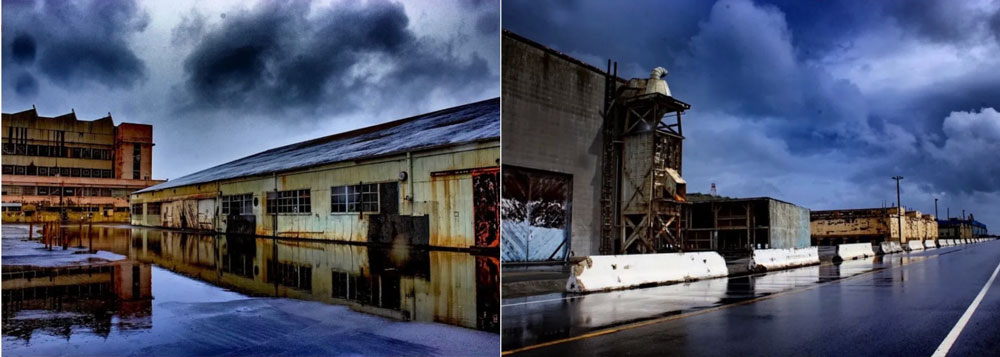
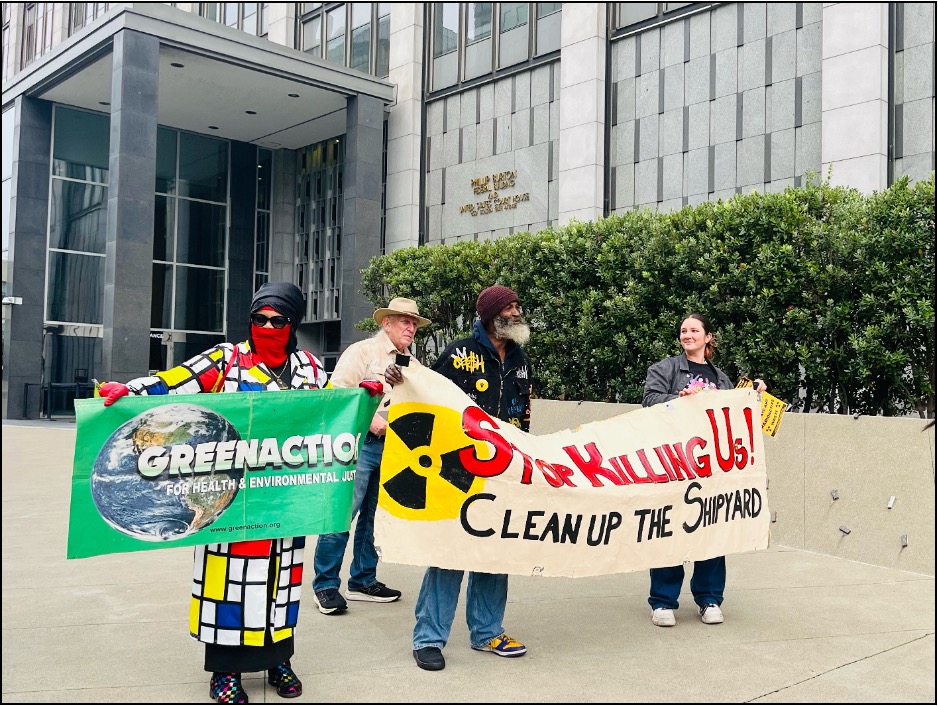
An article, Things You Cannot Hide, written by Dr. Ahimsa Porter Sumchai, caught my attention in the Westside Observer in the August 2025 edition. Because of the profound nature of the act the Navy is planning, I thought I would amplify her work and provide a Resolution from the Coalition for San Francisco Neighborhoods (CSFN) condemning the action of using explosives to demolish six buildings in the Hunters Point neighborhood.
Dr. Sumchai attests that these buildings are radioactive; she has questions that need to be answered by the Navy and the City of San Francisco before this project goes forward. The site remediation at Parcel G is only 60% complete. Therefore, the Human Health Risk Assessment is unfulfilled.
In 2020, the Department of Health assured the Police Department that building 606, on the radioactive Parcel E of the Hunters Point Naval Shipyard, was safe. Unfortunately, two officers who worked in building 606 became ill with brain and thyroid cancer. Building 606 borders Parcel G, which is being considered for demolition by explosives.
There is a long list of poor behavior exhibited by the Navy that we should consider. First, in Oahu, Hawaii, in December 2021, jet fuel was found in the water supply of the Red Hill Bulk Fuel Storage Facility. This water supply provided 93,000 military base residents with the necessary water. 1,000 health complaints were made public, as the water residents drank caused them to vomit and become nauseated. Testing found the water had 350 times more petroleum hydrocarbons than the "safe" threshold. The first response from the Navy was to "contest the order" and claim the water was safe to drink. The Sierra Club and Earth Justice provided legal help and guidelines to restore safe drinking water. A public water storage facility was just a mile away from this tainted water for the Navy. The public water supply provided water for 20% of the region's residents. The Navy was fined $325,000 for this maintenance and operation violation.

The Navy exhibits poor behavior. Can we really trust their judgment that the buildings located on Parcel G are safe for demolition by explosion?
Instead of using explosives to blow up these six buildings, which are so close to population centers, wouldn't it be best to demolish these buildings in the usual manner? An explosion will create a dust cloud that will impact the Palou Avenue neighborhood, with playgrounds, schools, churches and transit lines. And worse, the toxic debris must be removed — traveling down numerous side streets to Third Street, exposing all those passing by to heavily poisonous dust.”
Then, in 2019, a basketball-size chunk of radioactive dirt was found on Treasure Island beneath a residential walkway, deemed safe for habitation by the Navy. The island could easily have been deemed a Superfund site, but well-connected politicians, with spouses involved in real estate, denied this designation.
Then, Tetra Tech, EC Inc., which provided environmental remediation, was fined $97 million for falsifying soil samples in the work they performed at Hunters Point for the Navy in 2016. Two supervisors were convicted and sentenced in 2018 for false claims and racketeering
A final point is that the pre-shipyard land in the Hunters Point area was disturbed by grading for the construction of the Naval facility. Peeling off the topsoil decimated indigenous plants that grew in that environment.
Serpentine soil has few ingredients that allow exotic plants to thrive. Removing the soil cover and the native plants with it was a grave mistake; it transformed the soil into dust, which is easily moved around by the wind. Hunters Point residents are left to breathe the dust. Serpentine soils contain high concentrations of heavy metals, including chromium, iron, cobalt, and nickel.
The Navy exhibits poor behavior. Can we really trust their judgment that the buildings located on Parcel G are safe for demolition by explosion?
Instead of using explosives to blow up these six buildings, which are so close to population centers, wouldn't it be best to demolish these buildings in the usual manner? An explosion will create a dust cloud that will impact the Palou Avenue neighborhood, with playgrounds, schools, churches and transit lines. And worse, the toxic debris must be removed — traveling down numerous side streets to Third Street, exposing all those passing by to heavily poisonous dust.
If and when any toxic debris is transported, it should be confined in a box, restraining the dust. Another possible solution is to enclose the debris in an envelope to trap dust.
All of this demolition, however, should occur after the Human Health Risk Assessment is recalculated for Parcel G and once the remediation, which is now 60% complete, is finalized. In this way, the scope of the problem can be better understood. Also, the Human Health Risk Assessment and the remediation for Parcel G must be monitored by a competent, honest, and responsible government agency and executed by a contractor with the same character. In the past, Sierra Club and Earth Justice lawyers oversaw the remediation. Maybe we can ask for their help again on this project. Again, the Bayview district does not need another contractor, like Tetra Tech, EC Inc., to replace soil samples, from a completely different location, to save money for their unscrupulous client.
Glenn Rogers, RLA,
President, Coalition for San Francisco Neighborhoods (CSFN)
Landscape Architect, License 3223
October 2025