Remember When We Voted to Streamline Commissions and Boards?
Here Comes the Commission Streamlining Task Force

Monette-Shaw
Can the Task Force Resist the Temptation to Overhaul — Not Just Streamline, Commissions?
SPECIAL REPORT: Undead, “TogetherSF” Lives on Disguised as “Blueprint.”
• • • • • • • • • • July 2025 • • • • • • • • • •
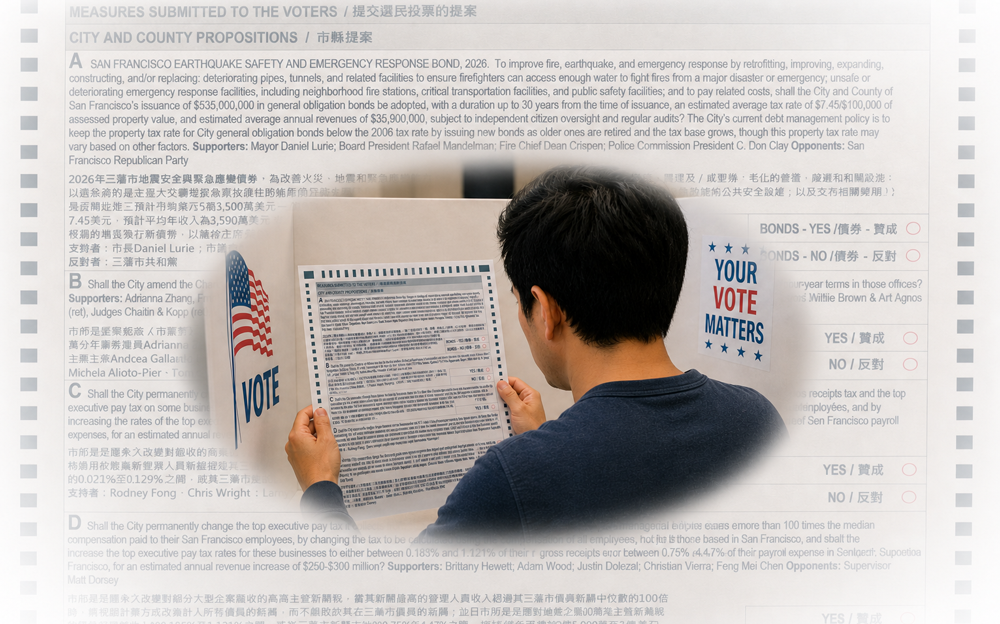
Voters passed “Prop. E” in November 2024 to establish a temporary five-member “Commission Streamlining Task Force” charged with making recommendations to the Mayor and the Board of Supervisors about ways to modify, eliminate, or combine the City’s appointive boards and commissions to improve the administration of City government.
Commission Streamlining Task Force Meetings Under Way ...
The Commission Streamlining Task Force website is located here. Their website is “kludgy,” at best. As of this writing, key documents the Task Force has reviewed or are relying on are not grouped together on a single, easy to access resource page, making it cumbersome to locate key documents. (I’ve made recommendations to the Task Force’s staff member about reorganizing its website.)
“Prop. E” established the five-member “Commission Streamlining Task Force,” charged with recommending ways to modify, eliminate, or combine the City’s boards and commissions. The goal is to improve the effectiveness, efficiency, and cost-effectiveness of city government administration. The Task Force must submit its recommendations by February 1, 2026.
“Prop. E” requires that the Board of Supervisors independent Budget and Legislative Analyst to prepare a cost-benefit report no later than September 1, 2025 analyzing the cost of the City’s current system of boards and commissions, as well as the projected financial impact of eliminating or consolidating commissions.
“Prop. E” also requires the City Attorney to prepare a Charter Amendment to implement the Task Force’s recommendations relating to commissions established in the Charter. The Board of Supervisors is required to hold a public hearing no later than April 1, 2026 on the Task Force’s recommendations and a draft Charter Amendment to be presented at a future municipal election.
Progress and Meetings Held So Far
The Task Force held its first meeting on January 31, 2005 and elected its officers as Chair and Vice Chair. It has held another eight meetings through June 18, with the first three or four meetings considering recommendations on how to approach its work, evaluating the 150 Commissions and policy bodies under its purview.
Nine Task Force meetings were held between January and June 18. A list of the Commission Streamlining Task Force’s past meetings since its inception in January is can be found here, listed in reverse date order. By clicking on any meeting date, its hyperlink will take you to that particular meeting’s agenda, minutes of previous meetings, and explanatory background files associated with specific agenda items presented during that meeting.
As part of its initial work, the Task Force decided to group the 150 boards and commissions into three separate categories by function. The categories are:
Governance: Decision-making bodies with significant authority to make policy and direct the work of City departments. The Streamlining Task Force identified San Francisco has 28 governance bodies.
Regulatory: Decision-making bodies who uphold and enforce existing law. Often responsible for approving rates, permits, contracts, etc., and/or holding hearings and settling disputes. The Task Force identified San Francisco has 16 regulatory bodies.
Advisory: Non-decision-making bodies who contribute expertise and advise City departments, elected officials, or decision-making bodies. The Task Force identified San Francisco has 87 advisory bodies.
Other: A placeholder category for bodies that do not fit neatly into proposed typologies. Examples include Staff working groups, and bodies that oversee the healthcare and retirement plans for City employees.
July 16 Meeting
During its July 18 meeting, the Task Force voted on whether to eliminate and remove 34 inactive policy bodies from the City’s Administrative Code contained in a list of 150 boards and commissions in the Streamlining Task Force’s “Commission Workbook” maintained in Microsoft Excel. City Administrator staff had identified and recommended the Task Force eliminate those inactive bodies, given they had essentially become inactive. (Decisions on three of the 34 inactive bodies have been deferred for further discussion at a future Task Force meeting.) That leaves approximately 106 commissions and policy bodies the Task Force is continuing to assess. No other bodies will be evaluated for elimination beyond that initial list at this time.

Voters may recall that then-candidate for Mayor, Mark Farrell and his spin-off group — “Together SF,” formed by Kanishka Cheng — were the official sponsors of “Prop. D,” a competing ballot measure in November 2024, that recommended taking a meat ax to the City’s approximately 150 boards, commissions, policy bodies, and policy advisory bodies. “Prop. D” started out saying there should be no more than 65 such bodies.”
In addition, the Task Force was presented with the first 83-page combined “template that will be used to assess “Advisory Bodies” and “Governance Bodies.” Unfortunately, the Task Force only managed to get through the first 40 pages on a template for “Advisory Bodies,” so the template for “Governance Bodies” was delayed until the Task Force’s August 6 meeting. It’s thought decisions reached on July 16 about the “Advisory Bodies,” will be reflected subsequently in an updated Template. More on what the templates involve, below.
Remaining Working Meetings August Through November
As of this writing in mid-July, the Streamlining Task Force now has seven more meetings scheduled through November 11 to consider various topics and issues in its Work Plan. According to its planned meeting schedule, the Task Force’s August 6 and August 20 meetings are devoted to finishing work on the “Policy Bodies” and “Governance Bodies” template, and then develop templates for “Appeals and Regulatory” bodies and “other” bodies. The Task Forces’ “Planned Schedule” was updated on July 14, but an earlier version is posted on the Task Force’s main website page under a different document named “Planned Decision Calendar,” dated July 8.
It is thought the City’s Budget and Legislative Analyst (BLA) will present it’s analysis of the costs to administer and run each of the 150 boards and commissions in the Task Forces “Commission Workbook” during a meeting in August. The draft BLA report will be provided to the City Administrator’s office for review and comment before it is finalized and submitted to the Commission Streamlining Task Force. The final BLA report is due by September 1, 2025 to the Task Force.
The Task Force is expected to use the BLA’s cost analysis in its deliberations of what to do with the remaining 104 boards and commissions.
The Task Force’s five meetings between September 3 and November 5 will dive into applying the Templates to assess policy bodies grouped into five major categories of governmental functions, including 1) Public Safety, 2) Infrastructure, Climate, and Mobility, 3) Housing and Economic Development, 4) Public Health and Wellbeing, and 5) General Administration.
The Task Force’s planned meeting for November 19 will involve complex and deferred decisions regarding the Templates or specific bodies, and other operational improvements. The Task Force’s current planned meeting calendar proposes to develop its draft report and other operational improvements.
On January 7 it will discuss proposed legislation for a charter amendment and ordinance. On January 21, it is scheduled to approve its final report. On February 4 it will present its proposed draft legislation, and on February 18 approve the proposed final legislation.
Unfortunately, the Task Force’s planned meeting calendar appears to conflict with the legal text of “Prop. E” voters passed last November. The “Prop. E” legal text stated the main deadline for the Streamlining Task Force to submit its recommendations to the Mayor and Board of Supervisors about ways to modify, eliminate, or combine the City’s appointive boards and commissions to improve the administration of City government is February 1, 2026. That seems to conflict with the February 18 date listed in the Task Force’s meeting calendar.
So, the Task Force’s calendar appears to potentially be off by two weeks. We’ll have to see how the Task Force revises its planned meeting schedule.
The “Prop. E” legal text says the City Attorney is required to prepare a draft Charter Amendment by March 1, 2026 to implement the Task Force’s recommendations relating to commissions established in the Charter. The Board of Supervisors is required to hold a hearing by no later than April 1, 2026 on the Task Force’s recommendations.
Designing of the “Templates”
The Streamlining Task Force is in the process of developing “templates” for three or four main categories of boards and commissions, grouped into “governance,” “regulatory and appeals,” “advisory,” and “other.”
The templates involve recommending the size of bodies, the type of authority to create bodies (wehter via the City Charter, Administrative Code, the Board of Supervisors, or by an individual City department), the sunset dates for when bodies end, appointing authority of members to bodies and member removals, term lengths and term limits, qualifications required to serve as a member, and compensation or stipends for members.
The templates are ostensibly part of a broader process to establish the ideal structure and criteria for evaluating each public body. The Task Force is still exploring whether using templates can help standardize and improve the structure and function of the City’s numerous commissions.
The templates are a tool to ensure a consistent and structured process to evaluate the list of existing bodies purpose, structure, appointment process, and effectiveness, in order to inform the Streamlining Task Force’s eventual final recommendations. The templates will be used to help determine whether a body should be retained as-is, retained but modified (to conform with the template), consolidated with another body, or eliminated.
As a “platonic ideal,” the initial working goal of the templates is to help the Task Force members organize their general thoughts on what defines different kinds of bodies.
Eliminating from the City charter the requirement to submit annual reports appears to go beyond the Streamlining Task Force’s remit to only streamline, not overhaul, structures of City commissions.”

The templates may potentially be used to retroactively change composition of existing governance bodies. For instance if there are current seat-level qualifications for members of policy bodies, they may be changed to “body-level” membership qualifications that would apply to all seats. That may affect the diversity of viewpoints and equity issues within a given policy body.
Task Force Chair Ed Harrington cautioned Task Force members on June 4 against “dramatically altering the city’s commission structure, stating that Proposition E was about streamlining, not radically overhauling, public governance.”
The templates may eventually end up being used as some sort of new policy document as guidelines for creation of future governance and advisory policy bodies, potentially “enshrined” as some sort of document housed in the City Attorney’s Office to guide future Mayoral or Board of Supervisors actions in creating new boards, commissions, and advisory bodies. Where the template parameters will live for future reference has yet to be determined by the Task Force, and the Task Force hasn’t decided yet whether, or how, to try to enforce the template decisions on bodies that don’t yet exist and would be created in the future.
Planned Streamlining Task Force meetings by policy area scheduled for this fall will be the forum in which the Task Force and City Administrator staff will evaluate existing bodies against the templates, to help Task Force members make decisions on how to proceed for particular bodies. City Administrator staff supporting the Task Force plan to post “staff recommendations” on the Task Force’s website at least two weeks in advance showing how each commission or other public body’s current configuration compares against the template, and what changes, if any, the Task Force recommends.
A Major Problem with the Initial Template
The templates and associated criteria for “Advisory and Governance Bodies” considered by the Streamlining Task force on July 16 had at least one major problem. Slides 33 for “Advisory Bodies,” and slide 73 for “Governance Bodies,” both questioned the need for an “Annual Statement of Purpose” and “Annual Reports” for each city Board or Commission to submit to the Mayor and to the Board of Supervisors, as required by City Charter §§ 4.102 and 4.103. These annual reports are meant to describe and assess how well a Board and Commission is performing its own duties, distinct from more extensive annual reports issued by a City Department reporting on the overall performance of the Department. The two different annual reports were designed for two distinct evaluation purposes. They aren’t the same thing or synonymous.
It’s thought the City Charter included both provisions as a tool to describe and evaluate how well each Board and Commission is focusing on its own activities performing its oversight task of the City Departments they oversee.
The Task Force may be considering eliminating both annual requirements, under the excuse that it is “unclear if most bodies have been, or are currently, complying with those Charter requirement.” As of July 16, only one of the five members of the Streamlining Task Force had voted to retain the requirement for annual reports from the “Governing Bodies.” For all we know, the Streamlining Task Force may end up making a recommendation to the Board of Supervisors to remove §§ 4.102 and 4.103 from the City Charter, and eliminate these annual reports.
Eliminating from the City charter the requirement to submit annual reports appears to go beyond the Streamlining Task Force’s remit to only streamline, not overhaul, structures of City commissions.
And doing so would be a complete and huge mistake! Those annual reports should serve as a red flag, and signal to the Mayor and Board of Supervisors when a given Commission is having problems interfering with performing its oversight mandate(s) very well. The annual reports may also suggest when removing an appointed Commissioner for good cause is justified.
After all, this is analogous to the practice of requiring annual performance reviews for City employees. Why would you evaluate performance of City employees annually, but not evaluate the performance of a City Commission annually?
The Failure of “Prop D” Dried Up the Money Well
Voters may recall that then-candidate for Mayor, Mark Farrell and his spin-off group — “Together SF,” formed by Kanishka Cheng — were the official sponsors of “Prop. D,” a competing ballot measure in November 2024, that recommended taking a meat ax to the City’s approximately 150 boards, commissions, policy bodies, and policy advisory bodies. “Prop. D” started out saying there should be no more than 65 such bodies.
“Prop. D” backers — heavily funded by venture capitalist Michael Moritz — went so far as to suggest that San Francisco’s Health Commission and the Behavioral Health Commission (an advisory body to the Health Commission) both be eliminated completely. The backers didn’t care that the Health Commission is the “governing body” to both San Francisco General Hospital, the City’s long-term care nursing facility at Laguna Honda Hospital and Rehabilitation Center, and San Francisco’s network of 14 neighborhood-based primary health and mental health centers in the San Francisco Health Network.
The “Prop D” backers either didn’t know about, or didn’t care, that the Centers for Medicare Services requires skilled nursing facilities licensed by the State for eligibility to receive federal reimbursement as a participating provider in the Medicare and Medicaid (Medi-Cal) programs have a having governing body. LHH typically earns $400 million in Medicare reimbursement annually, which it couldn’t earn without a governing body. The backers didn’t care that 42 CFR § 483.70(d)(3), Governing Body, provides that the governing body is responsible and accountable for the skilled nursing facility’s QAPI (Quality Assurance and Performance Improvement) program, in accordance with 42 CFR § 483.75(f), or that the governing body is legally responsible for establishing, approving, and implementing policies regarding the management and operation of the skilled nursing facility, primarily to provide oversight.
As for SFGH, which is a Level I Trauma Center, California Health and Safety Code § 1798.161 pertains to trauma care systems within the state. The Health Commission is also charged with oversight as the governing body of SFGH as San Francisco’s Level I Trauma Center, and performs partial oversight of San Francisco’s local Emergency Medical Services Agency.
In addition, Cal. Welfare and Institutions Code §§ 5604 et seq. require local jurisdictions to establish and operate local mental health boards or, more recently, behavioral health boards to serve in an advisory role to the governing body, which may be both San Francisco’s Health Commission and Board of Supervisors.
The “Prop. D” backers didn’t care about the pesky statutory legal requirements. They just pulled out their ax, and started lawlessly chopping away, perhaps following “ flouting the rule of law.
In addition to “Prop. D’s” backers brazenly recommending that the Health Commission and Behavioral Health Commission should both simply be eliminated, they also recommended eliminating the Library Commission, Human Rights Commission, and Human Services Commission, among others. The campaign supporting Proposition D raised a substantial $9.5 million, and co-mingled funds with an independent ballot committee linked to mayoral candidate Mark Farrell that also contributed approximately $2.5 million.
Despite a war chest of about $12 million, the competing “Prop E” ballot measure introduced by then-president of the Board of Supervisors, Aaron Peskin, spent approximately $117,000, just enough to defeat “Prop. D” at the ballot box in a classic David-vs.-Goliath battle at the ballot box. “Prop. E” gained 192,540 “Yes,” votes, more than the 158,773 “Yes” votes “Prop. D” had received, so “Prop. E’s” more sensible commission reform proposal won the election easily.
“Prop D” Backers Flamed Out
Farrell and his mayoral campaign were fined $108,000 — the highest fine ever levied by San Francisco’s Ethics Commission for multiple violations of co-mingling campaign funds between his Mayoral Campaign and the “Prop. D” ballot initiative. As for former Supervisor’s legislative aides, Kanishka Cheng and Margaux Kelly who led the “Prop. D” ballot measure and were on the payroll of TogetherSF or TogetherSF Action, they’ve initially vanished from San Francisco political scene. But TogetherSF has been resurrected and rebranded under a new name, and is now back (more on this, below).
TogetherSF Action’s Implosion and Rebirth
Following the November 2024 election in which “Prop. D” faced a disastrous failure with voters rejecting it by 13% (56.7% against, 43.3% in favor), and the substantial vote passing “Prop E” by a 5.8% spread (5.9% in favor, vs. 47.1% against), the backers of “Prop. D” — TogetherSF and its political action committee affiliate, TogetherSF Action — essentially imploded.
Just two months later, “TogetherSF” vanished in thin air (apparently only temporarily), when the Mission Local reported on January 10, 2025 that Together SF — lead by Kanishka Cheng — decided to merge with “Neighbors for a Better San Francisco,” led by Kanishka’s husband, Jay Cheng. It’s not clear whether “TogetherSF” and its political arm, “TogetherSF Action” both merged with the “Neighbors” group.
By report, TogetherSF’s financial sugar-daddy, venture capitalist Michael Moritz, vowed he would not have anything to do with the merged entity of “Neighbors.” As one observer noted, “Moritz’s move has the unmistakable look of a venture capitalist dumping a failed investment,” referring to TogetherSF’s merger with “Neighbors.” Perhaps the disastrous failures of Kanishka Cheng and TogetherSF’s November 2024 election debacle drove Moritz away.
TogetherSF was reported to be sitting on $17 million in funding from venture capitalist Michael Moritz (before its poor performance in the November election) that it planned to spend heavily on future planned ballot measures for 2026 and 2028. TogetherSF planned one measure to replace district elections in San Francisco with at-large citywide elections, and another ballot measure to overhaul the City’s nonprofit contracting system, outlined in a secret 49-page 2023 presentation (“A San Francisco That Works for Everyone”) about its future plans that was uncovered the Phoenix Project, an influence-tracking group formed in 2024 that tracks money and influence in San Francisco politics. The Phoenix Project believes “TogetherSF” and the “Neighbors” groups are part of a larger astroturf network for big-monied interest groups backed by real estate and technology donors meddling in politics to reshape local politics to suit their own interests, transparent democracy interests be damned.
When TogetherSF imploded, merging with “Neighbors,” Kanishka Cheng moved on and took a job as Director of External Affairs at Prologis, Inc., a global leader in logistics real estate that develops high-quality properties, handling external affairs, and community engagement and advocacy. For her part, Margaux Kelly landed her golden parachute with the public relations firm Barnes, Mosher, Whitehouse, and Lauter (BMWL) as a vice president.
Jay Cheng claimed at the time of the January merger that his wife would not be part of the merged organization.
Typically, when two nonprofit organizations merge, their net assets are combined by law into the newly formed surviving entity, with net assets of the merging (non-surviving) organization transferred to the surviving organization. It’s a legal consequence of the merger. The surviving entity assumes all assets and liabilities of the merged entity.
IRS Form 990’s revealed TogetherSF had $7,151,871 in net assets at the end of calendar year 2023, while TogetherSF Action held $3,309,306 in net assets, also at the end of calendar year 2023, for a combined total of $10,461,177 in net assets that my have been assumed by (transferred to) the merged incarnation of “Neighbors for a Better San Francisco,” under Jay Cheng’s control.
Charity Navigator’s five-star rating system awarded zero stars to TogetherSF for its 35% score for the finance and accountability category.
We don’t yet know how large the net assets of TogetherSF and TogetherSF Action may have increased in calendar year 2024 before the January merger with “Neighbors.” TogetherSF’s Form 990’s for calendar year 2024 were due to the IRS by May 15, 2025 but it typically takes another six months after that date before their Form 990’s becomes publicly available, so we have no idea yet of how much of their net assets were transferred to the merged “Neighbors” entity. Husband and wife Jay and Kanishka — branded as married “political hacks” by former Supervisor Aaron Peskin in the San Francisco Examiner — surely know the dollar amount of the net assets.
We also don’t know what happened to the $17 million in pledged support from Moritz that TogetherSF claimed it had lined up for future ballot measures.
In addition to the record $108,180 fine against, and settlement with, Mark Farrell announced by the San Francisco Ethics Commission on November 4, 2024 the day before the municipal election alleging that Farrell’s “Prop. D” ballot measure committee had illegally funneled contributions to Farrell’s mayoral campaign committee, Jay Cheng’s “Neighbors” non-profit was separately fined nearly $54,000 in August 2024 by the Ethics Commission for failing to disclose campaign payments during the recall of former District Attorney Chesa Boudin. It’s somewhat ironic that although Jay and Kanishka Cheng purport to be advocating for transparency in City government, the couple has been affiliated with ballot measure campaigns that have repeatedly received Ethics fines.
Rebirth via Rebranding
Just six months after Kanishka Keng’s TogetherSF and Jay Cheng’s Neighbors for a Better San Francisco merged in early January into a single entity, on June 19 Mission Local published an article saying a new initiative called “Blueprint for a Better San Francisco” held its launch party at the swanky Westin St. Francis overlooking Union Square on June 18, 2025. TogetherSF is essentially back in action, merely rebranded using a different name.
“Moderate” politicians District Attorney Brooke Jenkins, State Senator Scott Wiener, and Board of Supervisors members Matt Dorsey, Bilal Mahmood, and Rafael Mandelman all showed up in support. “Blueprint” is launching with a $2 million annual budget. Also of concern is that the three City Supervisors who attended “Blueprint’s” launch party will be voting next spring on the recommendations the Streamlining Task Force is only half-way through assessing and analyzing.
Of note, Mission Local reported that Blueprint’s policy platform calls for “limiting the influence and scope of commissions” and “clarifying and strengthening the role of the mayor, language that mirror’s TogetherSF’s failed ballot measure last fall.
It’s concerning that the three city Supervisors who attended Blueprint’s launch kick-off party may end up being heavily lobbied by Blueprint over the Commission Streamlining Task Force’s eventual recommendations.
SFist also reported on June 19 that neither Moritz or Mayor Lurie want anything to do with the new outfit, “Blueprint,” since Jay Cheng is reportedly persona non grata, as Lurie’s inner circle has made clear. Politico has reported Republican megadonor billionaire Bill Oberndorf is bankrolling “Blueprint.”
Apparently, the Phoenix Project has filed a legal complaint against TogetherSF for operating as an undeclared political committee. We’ll have to see how the Phoenix Project deals with “Blueprint” as TogetherSF’s reincarnation.
“Blueprint” is now being billed as TogetherSF’s “evolution” — via mere rebranding — and a project of “Neighbors.” It’s unclear whether “Blueprint” is actually a “project” of the merged “Neighbor” group, or whether “Blueprint” will become a separate stand-alone non-profit organization.
As the Mission Local alluded to, this portends that as the Commission Streamlining Task Force’s work progresses through the remainder of the year, San Franciscans can expect “Blueprint” to keep advocating for eliminating as many boards and commissions as possible, and reconfiguring the boards and commissions that remain to hand Mayor Lurie a “strong mayor” get-out-of-jail-free card, and restrict involvement in commissions by members of the public as much as possible.
While “Prop. E” prevailed at the ballot box and the Commission Streamlining Task Force is well underway, Kanishka Cheng’s efforts with “Prop. D” to reduce the number of boards and commissions to just 65 remains an ongoing concern, since “Blueprint’s” policy platform is so hell-bent on limiting the influence and scope of commissions.
Now is the time to closely monitor proceedings of the Commission Streamlining Task Force, while we have the chance.
Monette-Shaw has been a columnist for San Francisco’s Westside Observer newspaper for almost two decades, and is a member of the California First Amendment Coalition (FAC) and the ACLU. He operates stopLHHdownsize.com. Contact him at monette-shaw@westsideobserver.com.
July 2025