A Gondola for One District — But No Sirens for 800,000 Residents
The Sirens Went Silent
— City Hall Went Quiet
Mr. Mayor, Turn the Sirens Back On

Monette-Shaw
• • • • • • • • • • March 2026 • • • • • • • • • •
What’s more important to San Franciscans: 1. District 7 Supervisor Melgar’s proposal for a single gondola for transportation of patients and visitors between the Forest Hill MUNI station up the hillside to Laguna Honda Hospital, or 2. Reactivation of San Francisco’s Outdoor Public Warning System (OPWS), which has been silent for seven years since the sirens were shut off in December 2019?
A Citywide Safety System Silenced for Seven Years
That question is a matter of priorities for San Franciscans writ large. Still, it has been relegated to a “policy decision” by elected City officials and mid-level City Hall managers and appointees.
In December 2023, the Westside Observer published a tribute article to Nancy Wuerfel about San Francisco’s “Emergency Warning Siren System,” noting it is a key component of our City’s disaster planning and preparedness. At the time, initial costs were estimated to have grown from $2 to $2.5 million to upgrade the entire 119-siren outdoor emergency warning system after it was shut off in 2019, to ~$7.5 million to reactivate.
Bring Back “Noon Sirens” Outdoor Warning System
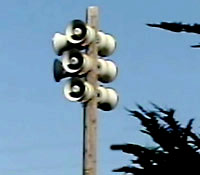
Mayor Lurie and the Capital Planning Committee removed the Outdoor Public Warning System from the Capital Projects plans.
Supervisor Wong introduced legislation to prioritize restoring the Outdoor Public Warning system as part of the City’s emergency preparedness efforts. The Tuesday “noon sirens” were shut off despite funding identified to restore the system, they remain silent.
Please share this petition widely with your contacts.
Two years later, the Westside Observer followed up in January 2025 with a second article that reported costs to replace and reactive the entire system had grown to potentially $20 million to $24 million.
Then, in response to a public records request the Westside Observer submitted on February 23, 2026, San Francisco’s Department of Emergency Management (DEM) provided an old “Next Steps” memo dated December 6, 2024—one DEM had not provided in response to prior records requests—which appears to be DEM’s most recent attempt to address turning the warning sirens back on.
Costs Climb While Action Stalls
The “Next Steps” memo revealed that the estimated cost to reactivate just 112 of the 119 sirens in December 2024 reached $20.8 million and may take fully six more years to bring them back online, once the project actually receives an approved budget allocation. Adding six years to the already seven-year silence means they will have been offline for at least 13 years, assuming no further delays.
Alternatively, DEM also proposes turning on 35 sirens for $8.5 million (up $1 million from previous estimates)—by only “prioritizing tsunami inundation and evacuation zones, and coastal areas” — for a partial fix.
As another alternative, DEM indicated some vendors proposed using portable trailer-mounted sirens as a potential alternative to a fixed system. But typically, trailer-mounted speakers are used only to supplement fixed-mounted siren systems, not to replace them entirely. Unlike sirens permanently mounted at fixed sites, trailer-mounted sirens require setup and staging in areas where they are needed, which is impractical and not always feasible during short-notice events. Another limitation of trailer-mounted sirens — they may not provide full coverage of an area unless multiple mobile units are deployed, in addition to their $378,000 per-unit cost.
A “Policy Question” — or a Public Safety Failure?
Disturbingly, DEM asserted that whether to fund a partial or complete restoration of the OPWS system is a policy question. Later, DEM asserted, “Funding is a policy question that would be determined by the Mayor, Board of Supervisors, Committee on Information Technology, Capital Planning Committee, and other stakeholders.” DEM’s hubris is palpable, because every day San Franciscans are left out of the policy decision-making debate, as if our voices and preferences — and our votes at the ballot box — are irrelevant in setting City policies!
Supervisor Wong’s Push for Immediate Restoration
District 4 Supervisor Alan Wong admirably introduced File #260142 on February 24, 2026 to the full Board of Supervisors, titled “Emergency Preparedness, Restoration of Outdoor Public Warning System.”
Each District Supervisor needs to rapidly sign on as a co-sponsor to Wong’s resolution and pass it unanimously. Then, they need to get to work identifying funding to rapidly repair the noon warning sirens and bring them back online by the end of September. Voters in each District are closely watching their action — or inaction — on this.

...even if restoring all of the City’s 119 sirens to service were to cost $20 million, that would again represent just 0.1257% — just over one-tenth of one percent — of the $15.9 billion annual City budget.”
The siren system must be declared an urgent matter for the City, and funding must be identified and dedicated rapidly to bring the sirens back online, as Priority Number 1 for the City. They should not have been offline for seven years already. It’s way past time the Department of Emergency Management stops “studying” this problem and moves on to taking real action!
And the City’s Capital Planning Committee (CPC) must be told to rapidly identify funding sources for the noon sirens in the upcoming Fiscal Year 2026–2027 City budget. Ten of the CPC’s 11 members are unelected City department heads, who are not accountable to San Francisco’s voters.
Budget Reality: A Fraction of 1%
After all, if the siren system were to cost $7.5 million, that represents just 0.047% of the City’s current $15.9 billion-dollar City budget. Alternatively, even if restoring all of the City’s 119 sirens to service were to cost $20 million, that would again represent just 0.1257% — just over one-tenth of one percent — of the $15.9 billion annual City budget. This is a ridiculously small percentage of spending to help all San Franciscans be more adequately alerted in the event of any number of public disasters. It’s the least the City should be doing, and can surely afford.
The outdoor warning sirens should be based on using the City’s 800 MHz radio system. DEM, which operates at 1011 Turk Street, is a highly secure, resilient backbone and the most efficient platform for hosting the analog siren system. After all, the AlertSF system was supposed to be a redundant backup for the sirens, the latter of which came first!
The False Promise of AlertSF
DEM has wrongly “framed” the outdoor warning system as a backup or redundancy. That’s completely backwards. The siren system came first, and all radio, broadcast TV, and digital alert systems connecting to the Internet and eventually to cell phones came later as additional tools to bolster the warning siren system. The sirens were installed back in 1942 to warn residents of potential air raids during World War II. The City’s AlertSF system became operational in 2011 or 2012, 50 years after the City's 1961 ordinance. So, AlertSF is the actual “additional tool,” and is somewhat redundant to the long history of developing our public alert warning systems.
As Supervisor Wong’s Resolution in File # #260142 notes, San Francisco's outdoor public warning system, consisting of approximately 119 sirens located throughout the City, was taken offline in December 2019 due to potential cybersecurity concerns, because the sirens were susceptible to being hacked and manipulated, and have remained non-operational for six years. Not an actual risk of being hacked or manipulated, but a potential risk of being hacked.
Real Disasters, Real Consequences
On December 5, 2024, the 7.0 magnitude earthquake off the coast of Humboldt County triggered a tsunami warning for San Francisco, during which the City lacked a functional outdoor warning system to supplement cell phone alerts, requiring first responders to drive to Ocean Beach with loudspeakers to warn residents physically.
San Francisco’s December 20, 2025 power outage, which affected approximately 130,000 San Francisco PG&E customers for up to 48 hours, demonstrated the vulnerability of relying solely on cell phone-based emergency alerts, as residents' phones lost battery power and with it, their ability to receive emergency notifications or contact 9–1–1.
The August 2023 Maui wildfires, which killed over 100 people in Lahaina, demonstrated both the limitations of cell phone-based alerts during power outages and the need for outdoor warning systems capable of broadcasting specific evacuation instructions.
Supervisor Wong’s proposed Resolution indicates San Francisco's AlertSF system, while valuable, has only approximately 195,000 subscribers out of more than 800,000 residents, leaving the majority of the population without opt-in emergency notifications.
DEM claimed in December 2024 that AlertSF only had 195,000 San Francisco residents subscribe to “AlertSF, out of 809,000 City residents, just 24.1% of San Franciscans. That leaves 75.9% vulnerable in the event of any disaster — they won’t receive any alerts.
But in response to a records request filed on December 5, 2024, DEM provided an Excel file showing that AlertSF had just 48,192 subscribers — just 5.96% of San Franciscans. By analyzing the Zip Codes and City names, only 36,152 of the 48,192 live in San Francisco — reducing AlertSF subscribers to just 4.5% of San Franciscans (36,152 of 809,000).
That AlertSF may actually reach only 4.5% of San Franciscans is unacceptable and suggests that the City’s failure to urgently fund and bring the Outdoor Public Warning Siren system back online is placing hundreds of thousands of San Franciscans’ lives at great risk.
Since the sirens went silent, we have seen projected costs escalate from $3 million to $7 million, then, at last count, perhaps $20 million. But it’s hard to believe the veracity of these figures, because after DEM began an RFI (Request for Information) process in April 2024, it has never advanced during 2025 to issuing an actual competitive-bid RFP (Request for Proposal) to obtain locked-in cost estimates.
Budget Reality: A Fraction of 1%
A City Hall press release on August 24, 2023, reported that then-Mayor Breed had joined then-Board of Supervisors President Aaron Peskin to announce plans to prioritize upgrading the City’s Outdoor Public Warning System (OPWS) during an August 2023 Mayor’s Disaster Council meeting.
The press release noted:
“Anyone who lived in San Francisco before December 2019 knows all too well the familiar Tuesday noon sirens test and the assurance that came with this safety message that boomed throughout the City, ” said Mayor London Breed. “The recent devastation in Maui was a tragic example of how important emergency notifications to residents, businesses and tourists are, and although we historically have had minimal need to use the sirens in San Francisco, we must be ready when the time comes. This additional tool will bolster our City’s existing comprehensive alert and warning system.
“While I was initially disappointed that this critical investment in our public safety infrastructure was not funded in the City’s Capital Plan, I am delighted that we were able to collaborate and find funds to finally get the Warning System back up and running,” said Board of Supervisors President Aaron Peskin.
What Happened to the 2023 Funding Promise?
According to that press release, funds to reactivate the sirens had reportedly been identified by Breed and Peskin. So why hasn’t the siren system been turned back on yet? What happened to those funds identified in 2023?
The Board of Supervisors must support the restoration of the outdoor public warning system as an important component of a comprehensive emergency alert strategy for protecting the lives and safety of San Franciscans, not just those who live in tsunami evacuation zones and coastal areas, since emergencies are typically citywide, not just confined to specific San Francisco neighborhoods.
It appears the project hit a snag and stalled for all of 2025 — until Supervisor Wong introduced his Resolution to prioritize the project in February 2026
If Mayor Lurie hopes to have any chance of being re-elected three years from now, he needs to prioritize funding to bring the OPWS system back online rapidly, before a disaster strikes under his watch as Mayor.
San Franciscans expect Lurie to get this problem solved and for the Mayor to work with DEM to develop and finalize an approved budget allocation for the next Fiscal Year 2026–2027 City budget, set to begin on July 1, 2026. From the time the allocation is approved, and an RFP is awarded for the project, it will take 36 months — or longer — to install and activate the complete siren system.
DEM’s “Next Steps” memo on December 6, 2024 stated:
“Upon approved budget allocation, bringing the system back online would take an estimated 3 years to 6 years to complete, issue a request for proposals (RFP), contract initiation, hardware installation, systems integration.
There was no explanation given for why the 36-month timeline might require an additional three years.
If that comes to pass, the siren system will have been silent for an entire decade, or possibly a decade-and-a-half, assuming there are no further project delays.
Gondola or Public Safety: A Question of Priorities
Rather than funding a single gondola project in a single City supervisorial district for Laguna Honda Hospital, shouldn’t restoring the complete 119-siren warning system be the City’s first priority?
Monette-Shaw is a columnist for San Francisco’s Westside Observer newspaper, and a member of the California First Amendment Coalition (FAC) and the ACLU. He is a Childless (and catless) Cat Daddy, and voter for 50 years. He operates stopLHHdownsize.com. Contact him at monette-shaw@westsideobserver.com.
March 2026