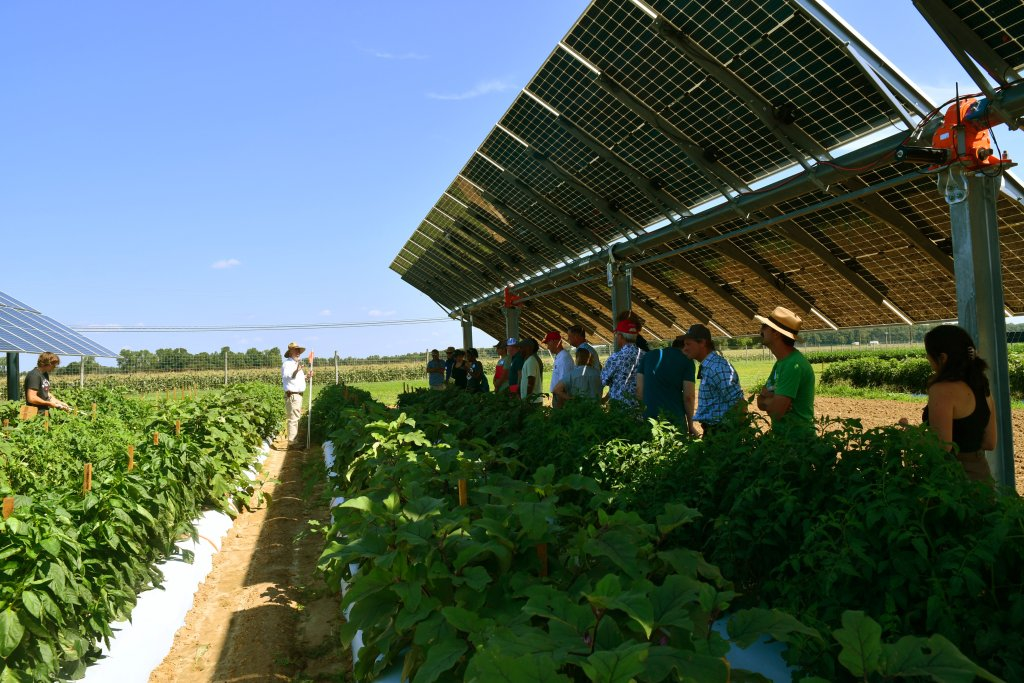
As drought, heat, and sinking land threaten California agriculture, agrivoltaics is emerging as a high-stakes solution that could save farms—and reshape the future of food.
Farming on the Brink — and the Sun May Be the Only Way Out
• • • • • • • April 2026 • • • • • • •

The reality of climate change is no longer a distant debate; it is a lived experience for the American farmer. Last year set global records for heat, and 2026 is projected to follow suit. Nowhere is this challenge more acute than in California’s Central Valley. This region, representing just 1% of U.S. farmland, produces a staggering one quarter of the nation’s fruits and vegetables.
However, intense heat is rewriting the rules of survival. As soil dries faster and aquifers are pumped to their limits—causing the very ground to sink—the old “food vs. fuel” dilemma has become a “water vs. existence” crisis. But a solution is emerging that replaces doomsday scenarios with a “win-win-win” business model: agrivoltaics.
A recent NPR special highlighted the promise of this approach through direct farmer testimony and growing research interest.
The Triple Benefit of Agrivoltaics
Agrivoltaics is the co-location of solar energy and agriculture on the same acre. This partnership creates a symbiotic microclimate that benefits the land, the power grid, and the farmer’s bottom line.
Water Conservation: In the Central Valley’s searing heat, solar panels act as a massive shade cloth, reducing soil evaporation by 30% to 50%. This slows the depletion of already imperiled aquifers.
Solar Efficiency: In a fascinating twist, the plants actually help the technology. Through transpiration, crops release moisture that cools the panels from below. Since solar panels lose efficiency as they overheat, this “natural air conditioning” can significantly boost energy output.
Grid Resilience: On-site generation allows farmers to power their own high-pressure irrigation pumps, insulating them from rising industrial energy costs. Any excess power can be sold back to the grid or neighboring farms.

Farming “volts” alongside vegetables is proving to be incredibly lucrative. On average, a farmer can generate significantly more income per acre from solar panels than from traditional crops alone.”
The Economics: A New Cash Crop
Farming “volts” alongside vegetables is proving to be incredibly lucrative. On average, a farmer can generate significantly more income per acre from solar panels than from traditional crops alone.
Consider a 10-acre farm: by dedicating just 2 acres to solar and keeping 8 acres for crops, a farmer can generate enough supplemental income to remain solvent during drought years. With 2.5 acres of solar, some projections show an annual return of up to $124,000.
The Superstars of the Shade
Not all crops are created equal under panels, but research from UC Davis and Arizona has identified several “superstar” crops that thrive in partial shade.
| Crop Category | Examples | Benefit |
|---|---|---|
| Leafy Greens | Lettuce, Kale, Spinach | Prevents “bolting” (early flowering) and keeps leaves tender. |
| Root Vegetables | Potatoes, Carrots, Beets | Potatoes have shown a 20% yield increase in shaded trials. |
| Climate-Resilient Crops | Tomatoes, Peppers | Reduces sunscald and may require up to 50% less irrigation. |
| Vineyard Crops | Wine Grapes | Helps maintain acidity levels by protecting grapes from intense midday heat. |
Designing the Future: Tractor-Ready Solar
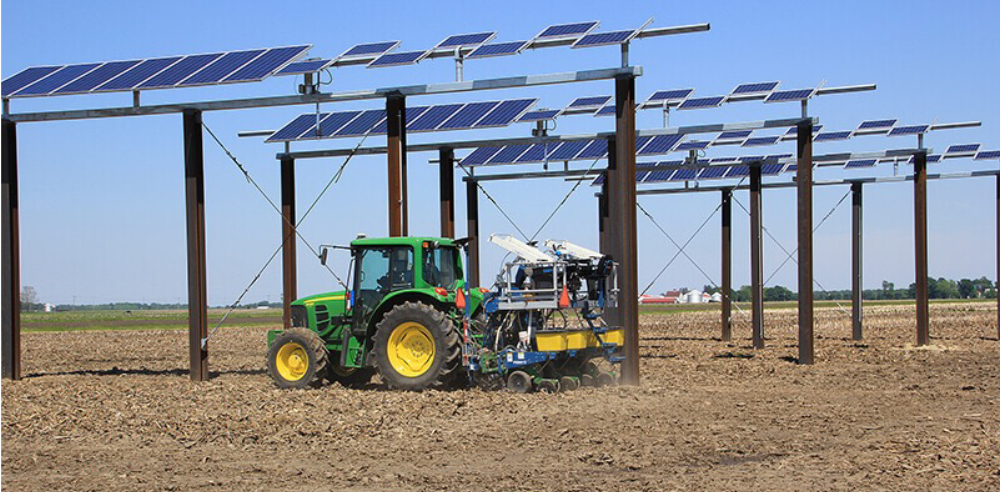
To make this work, engineering has moved beyond the standard fenced solar farm. Modern racking systems are designed with the tractor in mind.
Elevated Canopies: Panels are raised 10 to 16 feet high, allowing standard machinery to drive and harvest directly underneath.
Vertical “Solar Fences”: Bifacial panels stand upright in rows, leaving wide alleys—roughly 25 to 45 feet—for large farm equipment.
AI-Enabled Trackers: Smart panels can “stow” themselves, rotating into a flat or vertical position when it is time for the farmer to spray or harvest.
Fallow Land and the “Solar Sheep”
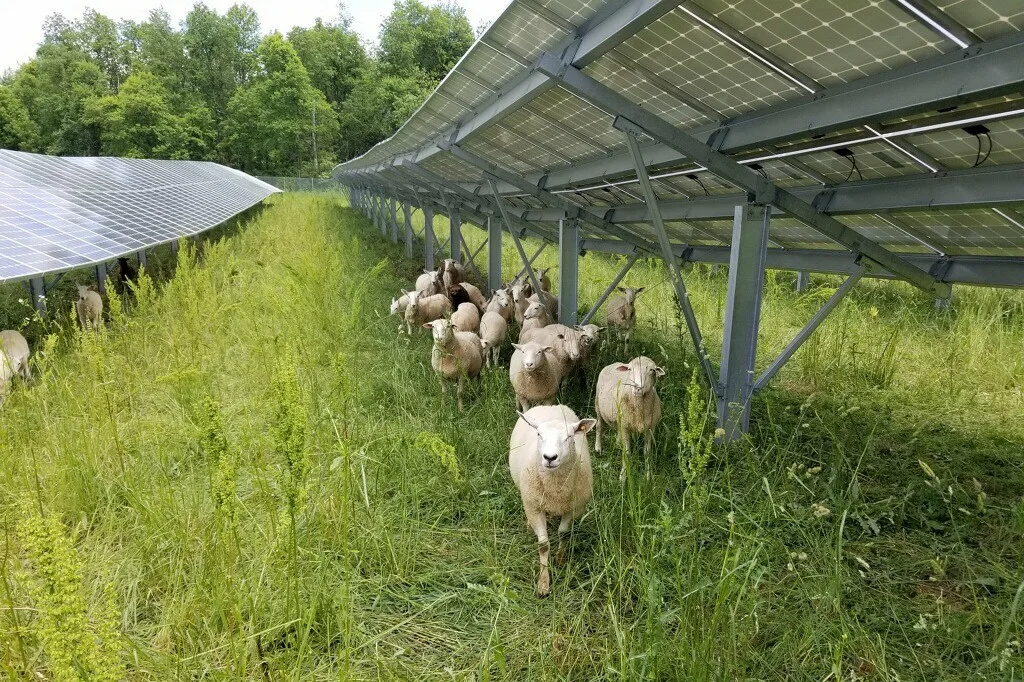
The lifespan of a solar panel is roughly 25 years. This aligns well with long-term land conservation. By allowing land to go fallow under panels, soil organic matter can recover from decades of intensive tilling.
Many farmers are now employing “solar sheep” to manage vegetation beneath the panels. These natural mowers do not chew wires the way goats often do, and they provide a steady stream of nitrogen-rich fertilizer. When the panels are eventually retired, the soil is refreshed, recharged, and ready for the next generation of farming.
Grants, Tax Credits and Funding
Farmers interested in agrivoltaics can explore a range of public incentives and support programs.
| Program | Type | Focus | Link Text |
|---|---|---|---|
| USDA REAP | Grant/Loan | Rural energy production | USDA REAP Portal |
| CDFA OARS | Grant | Agrivoltaic R&D resilience | CDFA OARS Site |
| Federal ITC | Tax Credit | 30%–70% cost reduction | Savings Here |
| CA SGIP | Rebate | Energy storage batteries | Storage Savings |
If you are a farmer ready to explore how agrivoltaics can transform your operational energy costs and reliability, consider using Solar Savings Direct, which specializes in installations in the Central Valley. Request a detailed assessment to discover exactly how much your operation could save with a customized solar energy system.
Glenn Rogers, RLA, Former President, Coalition for San Francisco Neighborhoods (CSFN) Landscape Architect, License 3223
April 2026